How to Read a Filet Crochet Chart: Rows, Squares and Direction
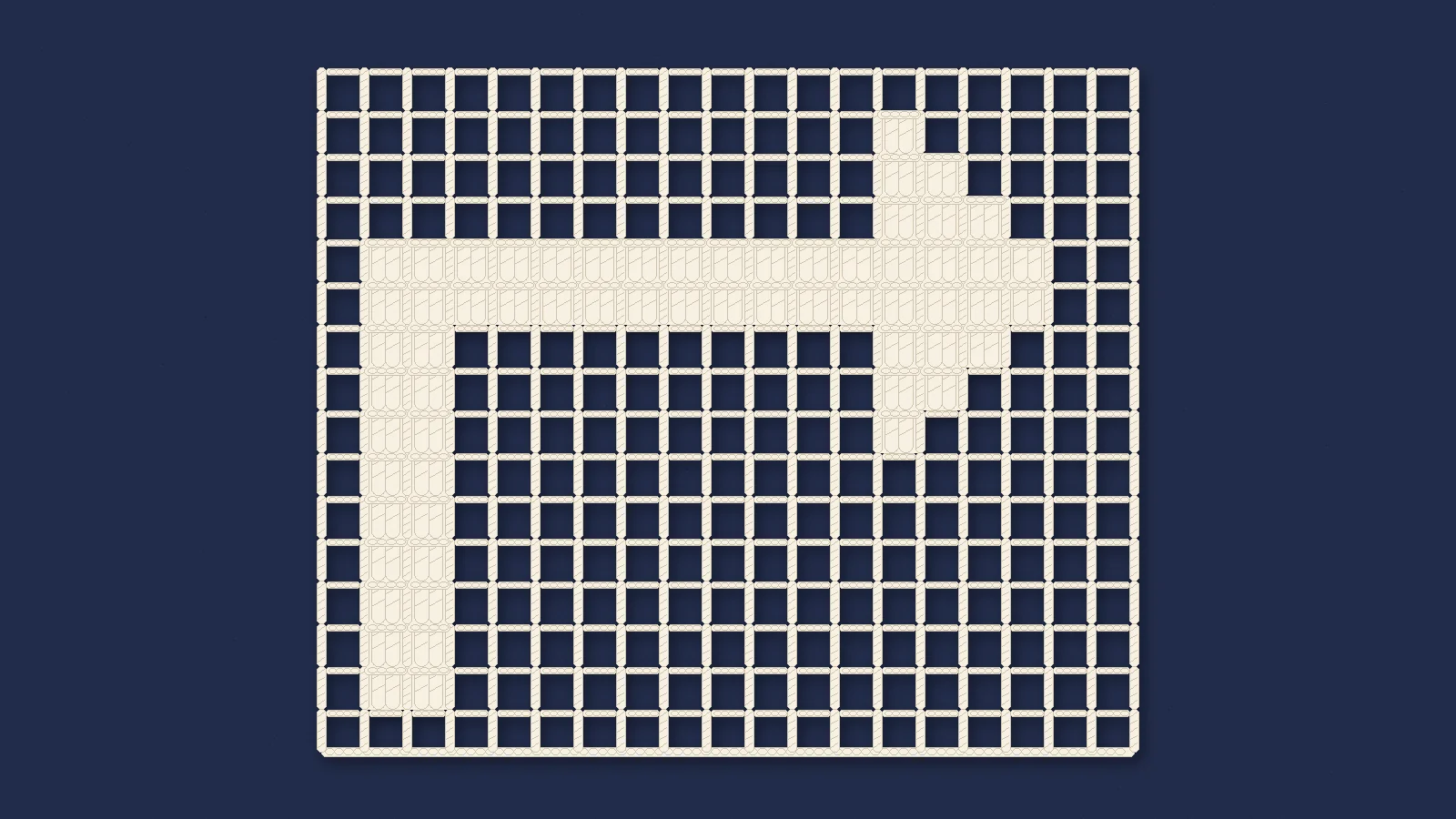
Start at the bottom: Row 1 is the bottom line of a filet chart, and you read it from right to left, the same way you crochet it. Row 2 runs back from left to right, and the directions keep alternating all the way up. Each square is one block or one space, 3 stitches wide plus a post it shares with the next square, and every row number sits on the side where that row begins.
The example chart in this guide is a bent arrow. It is not symmetric, so it shows straight away what happens when a row is read from the wrong end. It is designed and counted, not crocheted by us: the picture above is a drawing made from the chart.
The parts of a filet chart
- Filled squares are blocks, empty squares are spaces. Some charts mark blocks with a dot instead of a solid colour, so check the key.
- The chart shows the right side of the work, the side facing you when you work the odd rows.
- Row numbers run up both sides. On this site the odd numbers are on the right edge and the even numbers on the left, because that is where those rows start.
- Column numbers run along the bottom from the right, since Row 1 starts on the right.
- A heavier line every 5 squares helps you count long runs without losing your place.
- The facts list under each chart gives the size in squares, the foundation chain and the number of stitches in every row.
Row 1 is at the bottom
A filet chart is read from the bottom up. Row 1 is the bottom line, and the top line is the last row you work. The foundation chain is not a row: it is the base that Row 1 is worked into.
The first square you make is the bottom-right square of the chart. Whether it is a block or a space decides the foundation chain:
- First square a block: chain 3 for every square across, plus 3, and work the first double crochet in the 4th chain from the hook.
- First square a space: chain 3 for every square across, plus 5, and work the first double crochet in the 8th chain from the hook.
Every chart on this site has a border of open spaces, so its Row 1 starts with a space, and the facts list does the sum for you.
Which way each row goes
Odd rows go right to left. Even rows go left to right. The reason is simple: you work the first row after the foundation chain from right to left, then turn the work, so the next row travels back the other way across the chart. In every row, read the chart in the direction your hook is moving.
That is also why the row numbers sit where they do. Row 1 starts on the right, so its number is on the right. Row 2 starts on the left, so its number is on the left. Follow the number and you are at the start of the row.
The bent arrow shows how this plays out. Its Row 2, in working order, is 1 space, 2 blocks, 16 spaces: you start at the left edge, make one space, then the two blocks of the arrow’s stem. Its Row 3 is 16 spaces, 2 blocks, 1 space. Those are the same squares, met from the other end, so the two blocks of Row 3 land on top of the two blocks of Row 2 and the stem grows straight up.
Counting squares and stitches
Each square is 3 stitches wide, and neighbouring squares share the post between them. So a row of squares always has 3 stitches per square plus 1. The bent arrow is 19 squares wide, which makes 3 × 19 + 1 = 58 stitches in every row, counting the turning chain as the first.
Counting 58 stitches while you work is slow. Count posts instead: the upright double crochet at the edges of the squares. A row has one more post than it has squares, so the arrow has 20 posts in every row. A block is 4 double crochet counting both of its posts; a space is a post, 2 chains and a post.
What to work over the row below
Every square you make sits on a square of the row below, and what you do depends on both:
| Square below | Chart square | Work |
|---|---|---|
| space | space | ch 2, dc in the next dc |
| space | block | 2 dc in the ch-2 space, dc in the next dc |
| block | block | dc in each of the next 3 dc |
| block | space | ch 2, skip 2 dc, dc in the next dc |
Each line ends with a double crochet in a post of the row below. That is what keeps the squares stacked in columns.
Turning chains
The first square of a row decides how the row begins:
- Row starts with a block: ch 3 and turn. The 3 chains count as the first double crochet, the post on the edge. Then work the rest of the first block from the table above.
- Row starts with a space: ch 5 and turn. The 5 chains count as the first double crochet and the 2 chains of the first space. Then double crochet in the next post.
At the other end of the row, work the last double crochet into the 3rd chain of the turning chain below. That chain is the top of the double crochet the turning chain stands in for. Every row of the bent arrow starts with a space, so every row starts with ch 5.
Symmetric and asymmetric charts
A symmetric chart, where the left half mirrors the right square for square, comes out the same whichever end you read a row from. Hearts and diamonds are symmetric, like the practice square in what filet crochet is, which is a good first chart for that reason.
An asymmetric chart does not forgive. Letters, numbers, arrows and most animals are asymmetric. Read one row from the wrong end and its blocks land in the mirror positions, so that row comes out reversed and the motif breaks or flips. In the bent arrow, a mistake in Row 2 would put the stem on the right edge for one row.
Lettering reads correctly on the right side, the side facing you as you work the odd rows. Before you start an asymmetric chart, pencil an arrow at the bottom right corner of a printed copy so Row 1 starts in the right place.
Left-handed crocheters
If you crochet left-handed, reverse the directions: start at the bottom left, read and work the odd rows from left to right, and the even rows from right to left. The row numbers on this site’s charts then sit on the opposite side from where you start, so go by the row’s number, not its position.
Because you still read each row in the direction your hook is moving, the motif comes out the same way round as on the chart, seen from the side facing you on the odd rows.
The row tables on this site are written in right-handed working order. Read each entry backwards. Row 2 of the bent arrow, for example, becomes 16 spaces, 2 blocks, 1 space.
Practice chart: a bent arrow
The arrow rises from the bottom left, turns at the top and points right. It uses every kind of square from the table above, and because it is asymmetric it tells you at once if a row goes the wrong way.
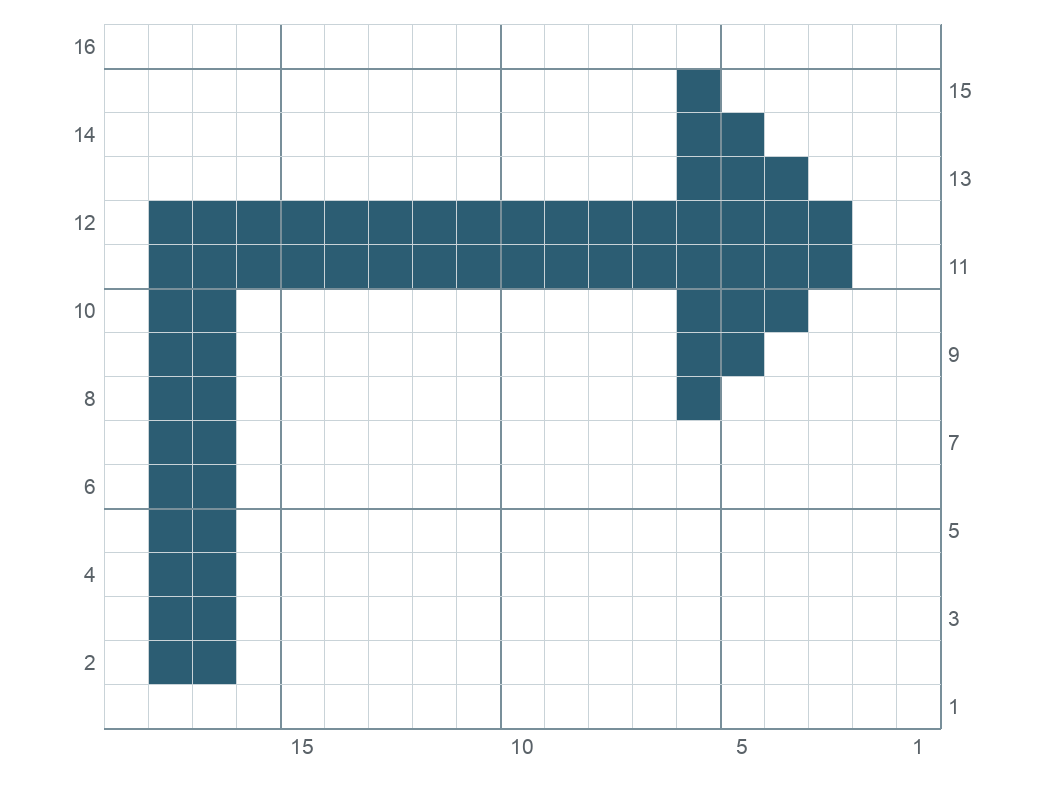
- Size: 19 squares wide, 16 rows tall.
- Foundation chain: chain 62, then dc in the 8th ch from hook (Row 1 starts with a space).
- Every row: 58 stitches, counting the turning chain as one.
Work it like this:
- Row 1. Chain 62, double crochet in the 8th chain from the hook, then ch 2, skip 2 chains, dc in the next chain, all the way across. That is 19 spaces.
- Rows 2 to 7 build the stem: a space at the edge, 2 blocks, then spaces to the end. In Row 2 the blocks go over spaces; from Row 3 they go over the blocks below. Check the stem is on the left edge of the chart each time.
- Rows 8 to 10 start the arrowhead on the right while the stem continues.
- Rows 11 and 12 carry the shaft across the top of the stem. Row 11, from the right, is 2 spaces, 16 blocks and 1 space.
- Rows 13 to 15 finish the arrowhead. Most of Row 13 sits over the solid shaft, so there you work spaces over blocks: ch 2, skip 2 dc, dc in the next dc.
- Row 16 is spaces all the way across, closing the open border.
Row by row
| Row | Work | Squares in working order | Blocks | Spaces |
|---|---|---|---|---|
| 1 | right to left | 19 sp | 0 | 19 |
| 2 | left to right | 1 sp, 2 bl, 16 sp | 2 | 17 |
| 3 | right to left | 16 sp, 2 bl, 1 sp | 2 | 17 |
| 4 | left to right | 1 sp, 2 bl, 16 sp | 2 | 17 |
| 5 | right to left | 16 sp, 2 bl, 1 sp | 2 | 17 |
| 6 | left to right | 1 sp, 2 bl, 16 sp | 2 | 17 |
| 7 | right to left | 16 sp, 2 bl, 1 sp | 2 | 17 |
| 8 | left to right | 1 sp, 2 bl, 10 sp, 1 bl, 5 sp | 3 | 16 |
| 9 | right to left | 4 sp, 2 bl, 10 sp, 2 bl, 1 sp | 4 | 15 |
| 10 | left to right | 1 sp, 2 bl, 10 sp, 3 bl, 3 sp | 5 | 14 |
| 11 | right to left | 2 sp, 16 bl, 1 sp | 16 | 3 |
| 12 | left to right | 1 sp, 16 bl, 2 sp | 16 | 3 |
| 13 | right to left | 3 sp, 3 bl, 13 sp | 3 | 16 |
| 14 | left to right | 13 sp, 2 bl, 4 sp | 2 | 17 |
| 15 | right to left | 5 sp, 1 bl, 13 sp | 1 | 18 |
| 16 | left to right | 19 sp | 0 | 19 |
Free printable PDF
Download the free bent arrow reading chart PDF (chart, starting chain and every row, 38 KB).
Troubleshooting
The stem jumps to the other side for a row. That row was read from the wrong end. Find the row number: work starts on that side.
A row has a square too many or too few. Count the posts. Every row of the arrow has 20, counting the turning chain as the first. If the row is short, check that the last double crochet went into the 3rd chain of the turning chain.
A block lands one square off. A long run of spaces was miscounted. Count the spaces in groups of 5 against the heavier lines on the chart.
You lose your place on the chart. Lay a ruler or a strip of card along the chart just above the row you are working, and move it up as each row is finished. Tick each row off on a printed copy as you go.
The squares are taller than they are wide, or the arrow looks squashed. Filet relies heavily on blocking. Pin the piece out square while it is damp and let it dry.
Sources
- Red Heart Design Team, filet crochet patterns and guides, for Row 1 at the bottom, the row directions and the 3-plus-1 stitch count.
- Susan Brittain and Karen Manthey, reading a colour chart for why odd rows go right to left, following a stitch diagram for row numbers and the left-handed direction, and filet blocks and filet spaces for the foundation chains and turning chains.
- Sandra Petit, The Crochet Cabana, filet crochet, for the foundation chain not counting as a row and the left-handed row directions.
- Becky Skuse, Simply Yarn, how to filet crochet, for charts showing the right side, dotted blocks and the last stitch in the turning chain.
- Joyce Geisler, Loving Threads filet placemat, for blocks and spaces over the row below and the blocking note.