What Is Filet Crochet? A Beginner's Guide and First Practice Square
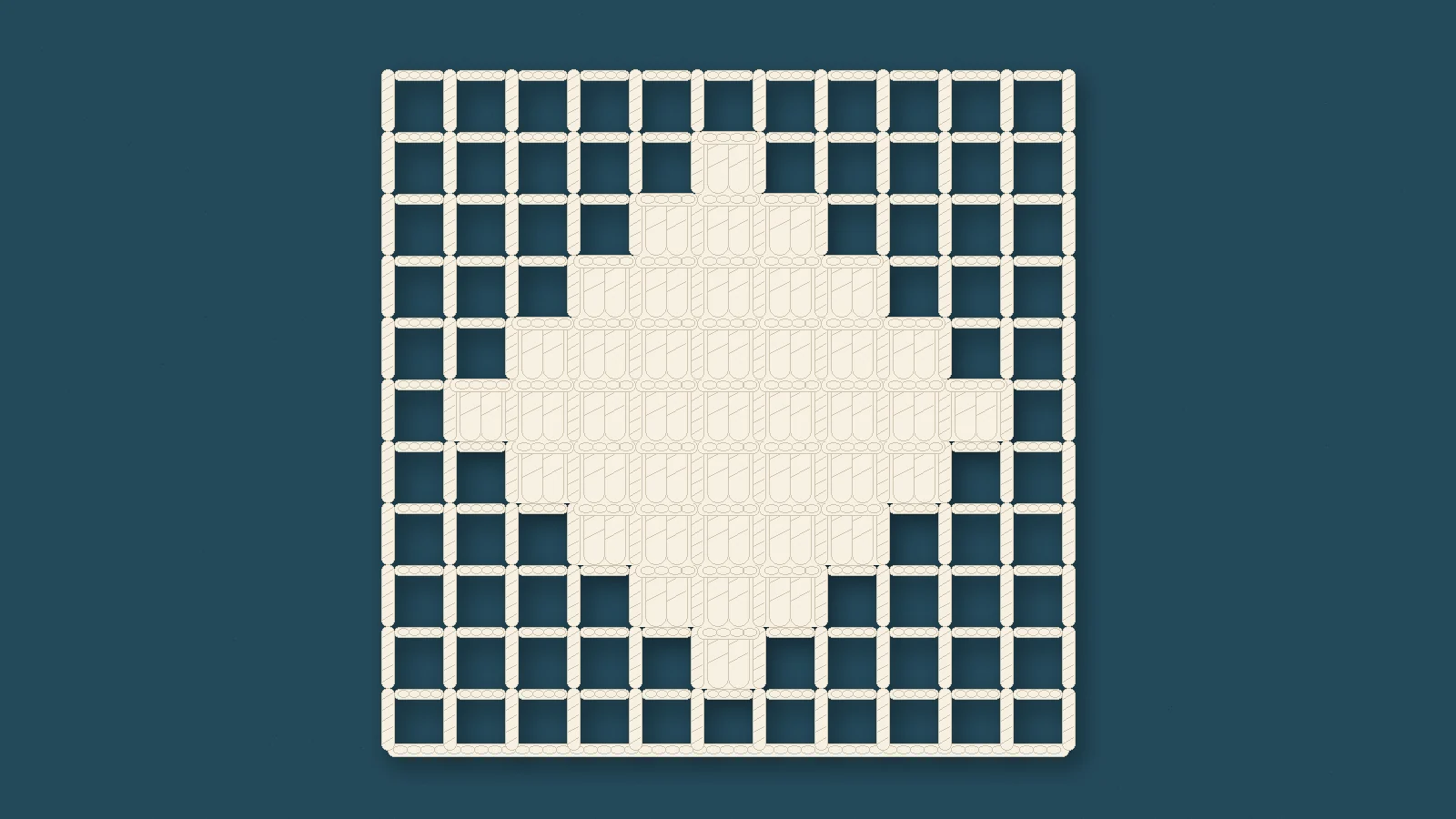
Filet crochet is crochet worked on a grid: every square of an open mesh is either left empty as a space or filled in as a block, and the filled blocks draw the picture. It uses only two stitches, chain and double crochet, and a chart that shows which squares to fill. The practice square in this guide is 11 squares each way: chain 38 and start in the 8th chain from the hook.
Everything here is designed and counted, not crocheted by us. The picture above is a drawing made from the practice chart, and any size given is an estimate from other designers’ published gauges.
How filet crochet works
Think of a sheet of graph paper. In filet crochet each little square on that paper becomes a square of crochet, and each one is either open or filled.
- A space is an open square: a double crochet, 2 chains across the top, and another double crochet.
- A block is a filled square: the 2 chains are swapped for 2 double crochet, so a block is 4 double crochet standing side by side.
The double crochet at the edge of a square is shared with the square next to it. That is why filet numbers always come in threes plus one: each square adds 3 stitches, and one more stitch closes the last square. A row of 11 squares is 3 × 11 + 1 = 34 stitches, counting the turning chain as the first.
The design is usually made of blocks on a background of spaces, which gives filet its look: a solid picture floating in an open net. Traditional filet is worked in fine white or ecru mercerised cotton thread, but the same method works in yarn, where the squares simply come out bigger.
The chart is the pattern. A filled square means a block and an empty square means a space. You read it from the bottom up, one line per row, and it shows the right side of the work.
A short history
The look is far older than the crochet. Filet lace was made by embroidering patterns into a knotted net, and one lace history records Exeter Cathedral owning four pieces of it in 1327. In 16th-century Italy the word filet was already tied to a knotted lace net whose holes were darned to make patterns.
Crochet itself is younger. The ASU FIDM Museum dates it as a separate craft to about 1800, and crochet of every kind was popular through the 19th century. Filet crochet imitates the netted lace with a hook: a crocheted mesh with some squares filled in. It reached the UK in the second half of the 19th century as a cheaper alternative to handmade lace. By the 1910s whole books of filet crochet patterns were in print: the Antique Pattern Library holds The Priscilla Filet Crochet Book from 1911 and about a dozen more from 1912 to 1921.
US and UK terms
This site uses US crochet terms. UK patterns use some of the same names for different stitches, and in filet that matters, because the whole technique rests on one stitch.
| US term, used here | UK term for the same thing |
|---|---|
| single crochet (sc) | double crochet (dc) |
| half double crochet (hdc) | half treble (htr) |
| double crochet (dc) | treble (tr) |
| treble (tr) | double treble (dtr) |
| gauge | tension |
So when a UK filet pattern says treble, it means the stitch this site calls double crochet. When a UK pattern says dc, it means our single crochet, a much shorter stitch.
Mesh sizes differ too. This site always puts 2 chains in a space. Some patterns, Simply Yarn’s filet guide among them, use a single chain, which changes every count. Follow the counts of the pattern in your hands.
What you need
- Cotton crochet thread. The practice chart is planned for size 10 mercerised cotton thread. The size number is a thickness, and the higher the number, the finer the thread. If size 10 feels too fine to see while you learn, practise first in size 3 thread or a smooth cotton yarn in DK weight or heavier.
- A hook to match. For size 10 thread, a steel hook of about 1.5 to 1.75 mm. For size 3 thread, about 2.5 to 3.5 mm. Go by the millimetres on the label: steel hook numbers run the other way round from yarn hooks, so a bigger number means a smaller hook.
- Scissors.
- A blunt tapestry needle for weaving in the two ends.
- Optional: spray starch and rustproof pins for blocking the finished square flat.
The two stitches you need
Chain (ch). Wrap the thread over the hook and draw it through the loop on the hook. That is one chain. When you count chains, never count the slip knot or the loop on your hook. The 1st chain from the hook is the one right next to it.
Double crochet (dc). Yarn over, insert the hook, yarn over and draw up a loop (3 loops on the hook), yarn over and draw through 2 loops, then yarn over and draw through the last 2.
Every square in filet is built from those two:
- Space: ch 2, then dc in the next stitch, so the 2 chains bridge the top of the square.
- Block: 3 dc, filling the same square.
Your first practice square
The chart is a small diamond on an open border. Row 1 is all spaces. A single block sits in the middle of Row 2, the diamond grows by one block on each side every row up to Row 6, then shrinks back the same way. In 11 rows it asks for every move a filet chart can make: space over space, block over space, block over block, and space over block.
The chart is symmetric, so its left and right halves match square for square. That makes it forgiving while you learn the row directions.
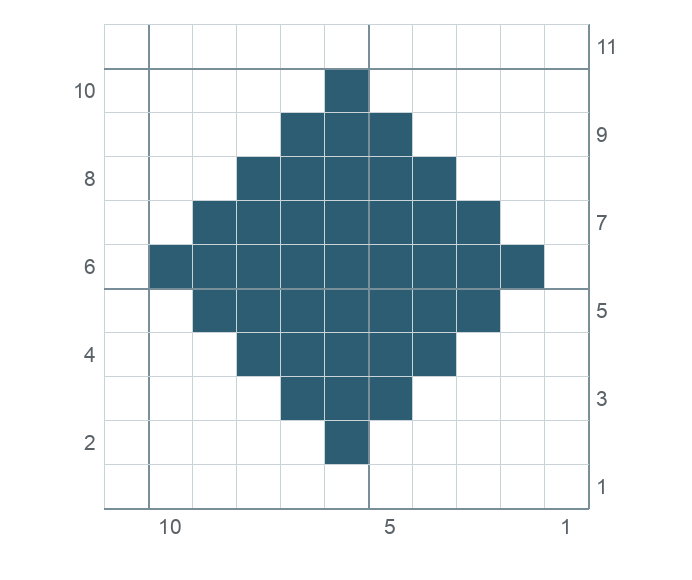
- Size: 11 squares wide, 11 rows tall.
- Foundation chain: chain 38, then dc in the 8th ch from hook (Row 1 starts with a space).
- Every row: 34 stitches, counting the turning chain as one.
- Finished size: about 2.75 to 3.7 inches (7 to 9.3 cm) each way in size 10 thread, before blocking.
In size 10 thread, published filet patterns work out at 3 to 4 squares per inch, which is where that size estimate comes from. Your own gauge decides the real size.
How to work it
- Row 1. Make a slip knot and chain 38. Double crochet in the 8th chain from the hook. Of the 7 chains you skipped, 3 stand in for the first double crochet, 2 make the top of the first space, and 2 are the chains that space spans. Then ch 2, skip 2 chains, dc in the next chain, and repeat from * to the end. You now have 11 spaces.
- Turn. Ch 5 and turn. Those 5 chains count as the first double crochet and the 2 chains of the first space. Every row of this chart starts with a space, so every row starts with ch 5.
- Follow the chart square by square: - Space over a space: ch 2, dc in the next dc. - Block over a space: 2 dc in the ch-2 space, dc in the next dc. - Block over a block: dc in each of the next 3 dc. - Space over a block: ch 2, skip 2 dc, dc in the next dc.
- End each row with the last double crochet in the 3rd chain of the turning chain below. That chain is the top of the “double crochet” the turning chain stands in for.
- Finish. After Row 11, cut the thread, pull the end through the loop, and weave both ends into the blocks with the needle. Filet relies heavily on blocking, so wash the square, blot it damp, pin it out square with rustproof pins and let it dry. A light spray of starch helps lace keep its shape.
Row by row
The table lists each row in the order you work it, so Row 1 reads from the right and Row 2 from the left.
| Row | Work | Squares in working order | Blocks | Spaces |
|---|---|---|---|---|
| 1 | right to left | 11 sp | 0 | 11 |
| 2 | left to right | 5 sp, 1 bl, 5 sp | 1 | 10 |
| 3 | right to left | 4 sp, 3 bl, 4 sp | 3 | 8 |
| 4 | left to right | 3 sp, 5 bl, 3 sp | 5 | 6 |
| 5 | right to left | 2 sp, 7 bl, 2 sp | 7 | 4 |
| 6 | left to right | 1 sp, 9 bl, 1 sp | 9 | 2 |
| 7 | right to left | 2 sp, 7 bl, 2 sp | 7 | 4 |
| 8 | left to right | 3 sp, 5 bl, 3 sp | 5 | 6 |
| 9 | right to left | 4 sp, 3 bl, 4 sp | 3 | 8 |
| 10 | left to right | 5 sp, 1 bl, 5 sp | 1 | 10 |
| 11 | right to left | 11 sp | 0 | 11 |
Free printable PDF
Download the free diamond practice square PDF (chart, starting chain and every row, 22 KB).
How to read a filet chart, in brief
- Row 1 is at the bottom. Work up the chart one line at a time. The foundation chain is not a row.
- Odd rows go right to left, even rows left to right. The first row after the foundation chain is worked from right to left, and every row after it turns.
- The row number sits on the side where that row starts. On this site’s charts the odd numbers are on the right edge and the even numbers on the left.
- Count squares, not stitches, while you work. Count stitches only to check a finished row: 3 per square, plus 1.
- Left-handed? Do the reverse: start at the bottom left, work odd rows left to right and even rows right to left.
Troubleshooting
Row 1 has chains left over, or runs out. The chain count is off. Count again with a stitch marker in every 10th chain. A count short by exactly 2 usually means the chain was made for a row that starts with a block, 3 × 11 + 3 = 36, instead of one that starts with a space, 3 × 11 + 5 = 38.
A row ends a square long or short. Count the posts, the upright double crochet at the edges of the squares. A row of 11 squares has 12 posts, counting the turning chain as the first. A lost square is most often the last stitch, which belongs in the 3rd chain of the turning chain and not in the double crochet just before it.
The diamond comes out lopsided. Every row of this chart has the same number of spaces before its blocks as after them. Count the spaces on each side of the blocks as you finish a row, and the mistake shows up at once.
The foundation chain is so tight that Row 1 is a struggle to work into. Next time make the chain with a slightly larger hook, then go back to your usual hook for Row 1.
The mesh looks crooked or the square curls. Block it. Pin each corner and each edge straight while it is damp and let it dry flat, with spray starch if you want it crisp.
Frequently asked questions
Do I need to know many stitches? No. Filet uses chain and double crochet only. What takes practice is counting squares and keeping track of the row direction.
Can I use yarn instead of thread? Yes. Filet patterns are often, though not always, written for thread, and the method is the same in yarn. The Red Heart design team made a filet bookmark in Red Heart Super Saver yarn with a J hook. Thicker yarn makes bigger squares, so the same chart comes out larger.
What is the difference between filet lace and filet crochet? Filet lace is embroidery worked into a knotted net. Filet crochet makes the net and the filled squares together, in one fabric, with a hook.
Sources
- Becky Skuse, Simply Yarn, how to filet crochet: the 16th-century Italian filet net, filet crochet reaching the UK, charts showing the right side, the 1-chain mesh and practising in DK cotton.
- Wikipedia, filet lace, for the knotted net and the Exeter Cathedral record of 1327, and filet crochet, for the two stitches and the usual white or ecru cotton thread.
- ASU FIDM Museum, crochet, for crochet becoming a separate craft around 1800.
- Antique Pattern Library, filet crochet catalogue, for the pattern books of 1911 to 1921.
- Craft Yarn Council, crochet abbreviations and US/UK terms and steel hooks and crochet thread sizes.
- Susan Brittain and Karen Manthey, filet blocks, filet spaces and blocking with spray starch.
- Joyce Geisler, Loving Threads filet placemat, for blocks and spaces over the row below, a size 10 gauge, and the blocking note.
- Red Heart Design Team, filet crochet patterns and guides, for Row 1 at the bottom, the row directions, the 3-plus-1 stitch count and the yarn bookmark.
- Lion Brand, making a chain stitch, double crochet and starting your crochet project right, for counting chains, markers and a larger hook for the chain.
- DMC, Cébélia thread, and Handy Hands, Lizbeth thread-to-tool chart, for the hook sizes.
- Kim Guzman, Windmill filet, and Chris Rankin, Shelf Edging 1, for size 10 gauges.
- Sandra Petit, The Crochet Cabana, filet crochet, for the left-handed row directions.