Filet Crochet Rose Square: Easy Free Chart
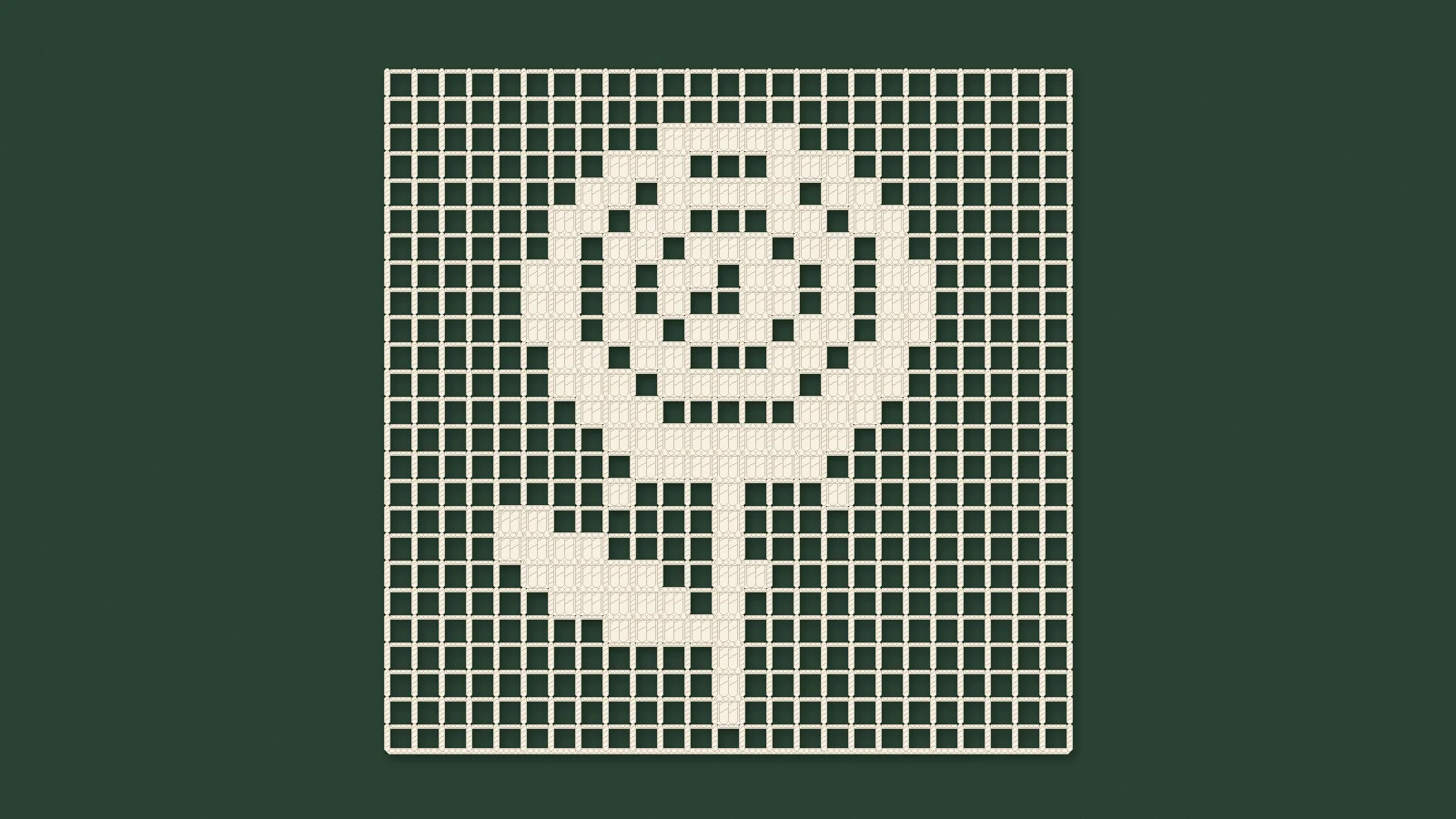
This filet crochet rose square is 25 squares wide and 25 rows tall: a spiral rose bloom on a straight stem, with one leaf, a thorn and a small cup under the bloom, all in solid blocks inside a ring of open spaces. Chain 80, work the first double crochet into the 8th chain from the hook, and start every row after that with chain 5. In size 10 crochet cotton the square comes out about 6¼ to 8¼ inches across before blocking.
Frame one on its own, or work three in a strip for a table runner: both are explained below, with the chart, every row written out and a free PDF. The rose is designed and counted, not crocheted by us: the picture above is a drawing of the chart, and the size is an estimate from published gauges. If this is your first filet piece, the easy filet crochet heart uses the same stitches on a smaller chart.
What you need
- Size 10 crochet cotton thread in any colour.
- A US 7 steel crochet hook, 1.5 to 1.65 mm. Steel hook numbers vary between brands, so go by the millimetres on the packet.
- Small sharp scissors.
- A tapestry needle with an eye the thread fits through, for the ends and for sewing squares together.
- For blocking: spray or liquid starch, rustproof pins, and a board covered in plastic wrap.
Pattern terms are US. A US double crochet (dc) is a UK treble (tr).
Size and gauge
Published filet patterns in size 10 thread on a US 7 steel hook give gauges from 4 squares and 4 rows to the inch (Maggie Weldon) to 12 squares and 13 rows to 4 inches (Chris Rankin). That puts the rose square at:
- Width: 25 ÷ 4 = 6¼ inches, up to 25 ÷ 3 = about 8¼ inches (16 to 21 cm).
- Height: 25 ÷ 4 = 6¼ inches, up to 25 × 4 ÷ 13 = about 7¾ inches (16 to 19.5 cm).
At the first gauge the piece is square. At the second it is about half an inch wider than it is tall, and you pin it square when you block it. A swatch tells you which you are closer to: chain 35, work 10 rows of 10 spaces, block it, and count the squares in an inch.
To frame it, block the square flat with starch and let it dry completely, then measure it before you choose a frame. The blocked size, not the estimate above, decides what fits.
To make a table runner, you have two ways:
- One long strip, no sewing. Work Rows 1 to 25, then Rows 2 to 25 again for each extra rose. The chain stays at 80, because the width does not change. Three roses take 25 + 24 + 24 = 73 rows, about 18¼ to 22½ inches long (73 ÷ 4, up to 73 × 4 ÷ 13). Rows 24 and 25 are spaces, so two rows of open mesh sit between one bloom and the next stem.
- Separate squares, sewn. Make each square, block them all to the same size, then lay two side by side and whipstitch the edges together with the same thread, matching the edges square for square.
The chart
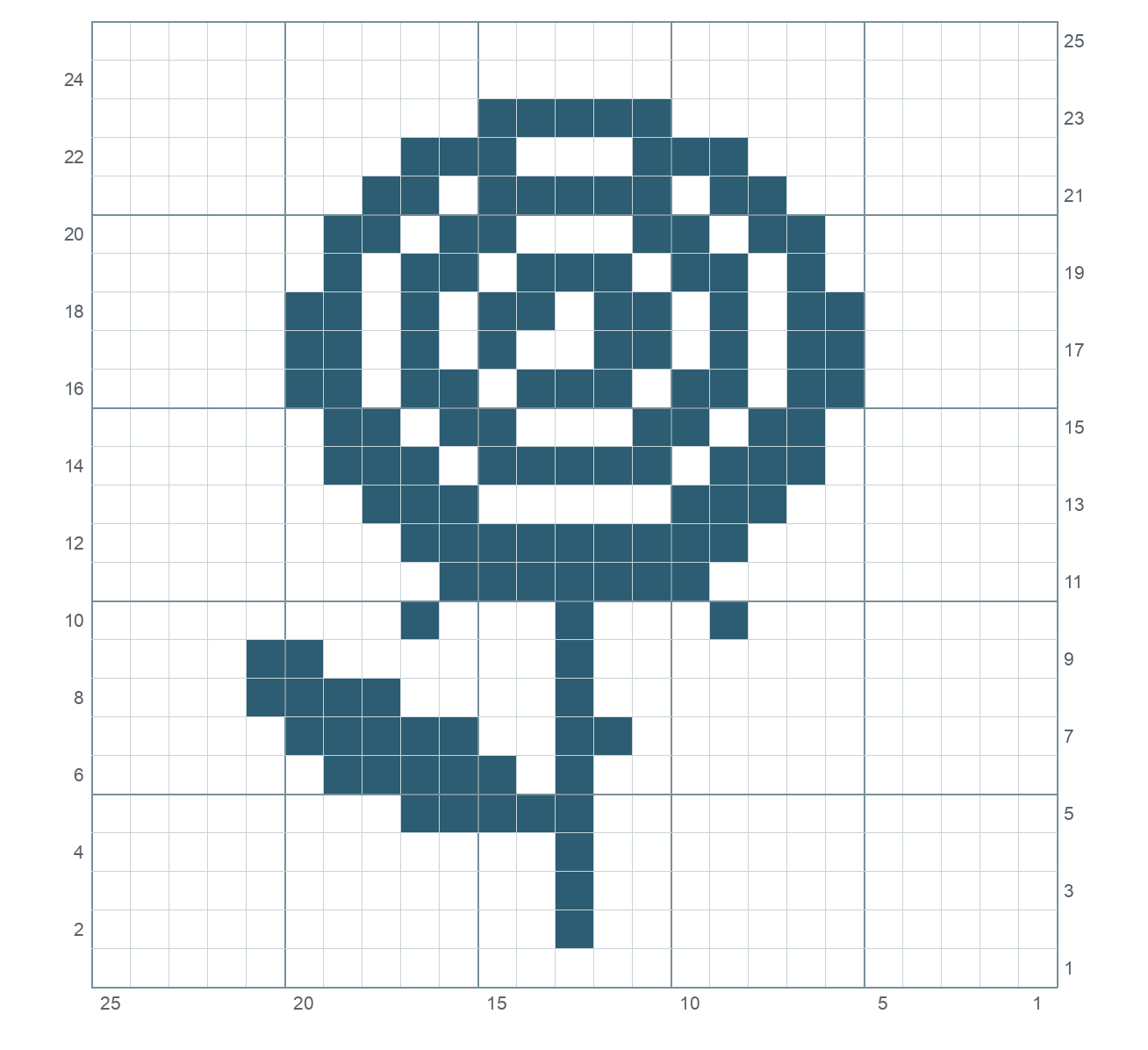
- Size: 25 squares wide, 25 rows tall.
- Foundation chain: chain 80, then dc in the 8th ch from hook (Row 1 starts with a space).
- Every row: 76 stitches, counting the turning chain as one.
- Finished size: about 6.25 to 8.25 inches wide and 6.25 to 7.75 inches tall (16 to 21 cm by 16 to 19.5 cm) in size 10 thread, before blocking.
A filled square is a block: three double crochet side by side. An empty square is a space: a dc, two chains across the top, then the next dc. Neighbouring squares share the dc between them, so a row of 25 squares has 76 stitches.
Row 1 is the bottom line. Read the chart in this order as you go up:
- Rows 2 to 10: the stem, one block wide, in the middle of the row.
- Rows 5 to 9: the leaf, on the left of the stem, pointing up. Row 7 adds one thorn on the right.
- Rows 10 and 11: the small cup under the bloom, with three pointed tips in Row 10.
- Rows 12 to 23: the bloom. Lines of spaces wind through the blocks like the edges of the petals.
- Rows 1, 24 and 25: spaces all the way across, the ring that frames the rose.
How to work it
Row 1. Chain 80. Work 1 dc into the 8th chain from the hook: the 7 chains you skip stand in for the first dc, the two chains across the top of the first space and the two chains it skips. Then work (chain 2, skip 2 chains, 1 dc into the next chain) 24 times, to the end of the chain. You have 25 spaces.
Turning. Turn at the end of every row. Because of the ring of spaces, every row of this chart starts with a space: chain 5 (counts as the first dc and chain 2), skip the next 2 stitches or the chain-2 space, and work 1 dc into the next dc.
The four moves:
- Space over a space: chain 2, skip the chain-2 space, 1 dc into the next dc.
- Block over a space: 2 dc into the chain-2 space itself, then 1 dc into the next dc.
- Block over a block: 1 dc into each of the next 3 dc.
- Space over a block: chain 2, skip the next 2 dc, 1 dc into the next dc.
Ending a row. Every row ends with a space: chain 2, then 1 dc into the 3rd chain of the turning chain 5 below. On Row 2 that turning chain is the 7 chains you skipped at the start of Row 1.
The bloom rows. From Row 15 to Row 20, inside the spaces at each end, the spiral breaks every row into runs of only 1, 2 or 3 squares, so the count changes every few stitches. Say each run out loud as you work it, and check the finished row against the chart before you start the next. A stray block in the stem shows at once; one in the spiral is easy to miss until the curl looks wrong.
Finishing. After Row 25, cut the thread, pull it through the loop, and weave both ends in along the blocks. Block the square before you frame or join it.
Row by row
Odd rows are worked right to left, even rows left to right, in the order the squares appear in the table. “sp” is a space and “bl” is a block.
| Row | Work | Squares in working order | Blocks | Spaces |
|---|---|---|---|---|
| 1 | right to left | 25 sp | 0 | 25 |
| 2 | left to right | 12 sp, 1 bl, 12 sp | 1 | 24 |
| 3 | right to left | 12 sp, 1 bl, 12 sp | 1 | 24 |
| 4 | left to right | 12 sp, 1 bl, 12 sp | 1 | 24 |
| 5 | right to left | 12 sp, 5 bl, 8 sp | 5 | 20 |
| 6 | left to right | 6 sp, 5 bl, 1 sp, 1 bl, 12 sp | 6 | 19 |
| 7 | right to left | 11 sp, 2 bl, 2 sp, 5 bl, 5 sp | 7 | 18 |
| 8 | left to right | 4 sp, 4 bl, 4 sp, 1 bl, 12 sp | 5 | 20 |
| 9 | right to left | 12 sp, 1 bl, 6 sp, 2 bl, 4 sp | 3 | 22 |
| 10 | left to right | 8 sp, 1 bl, 3 sp, 1 bl, 3 sp, 1 bl, 8 sp | 3 | 22 |
| 11 | right to left | 9 sp, 7 bl, 9 sp | 7 | 18 |
| 12 | left to right | 8 sp, 9 bl, 8 sp | 9 | 16 |
| 13 | right to left | 7 sp, 3 bl, 5 sp, 3 bl, 7 sp | 6 | 19 |
| 14 | left to right | 6 sp, 3 bl, 1 sp, 5 bl, 1 sp, 3 bl, 6 sp | 11 | 14 |
| 15 | right to left | 6 sp, 2 bl, 1 sp, 2 bl, 3 sp, 2 bl, 1 sp, 2 bl, 6 sp | 8 | 17 |
| 16 | left to right | 5 sp, 2 bl, 1 sp, 2 bl, 1 sp, 3 bl, 1 sp, 2 bl, 1 sp, 2 bl, 5 sp | 11 | 14 |
| 17 | right to left | 5 sp, 2 bl, 1 sp, 1 bl, 1 sp, 2 bl, 2 sp, 1 bl, 1 sp, 1 bl, 1 sp, 2 bl, 5 sp | 9 | 16 |
| 18 | left to right | 5 sp, 2 bl, 1 sp, 1 bl, 1 sp, 2 bl, 1 sp, 2 bl, 1 sp, 1 bl, 1 sp, 2 bl, 5 sp | 10 | 15 |
| 19 | right to left | 6 sp, 1 bl, 1 sp, 2 bl, 1 sp, 3 bl, 1 sp, 2 bl, 1 sp, 1 bl, 6 sp | 9 | 16 |
| 20 | left to right | 6 sp, 2 bl, 1 sp, 2 bl, 3 sp, 2 bl, 1 sp, 2 bl, 6 sp | 8 | 17 |
| 21 | right to left | 7 sp, 2 bl, 1 sp, 5 bl, 1 sp, 2 bl, 7 sp | 9 | 16 |
| 22 | left to right | 8 sp, 3 bl, 3 sp, 3 bl, 8 sp | 6 | 19 |
| 23 | right to left | 10 sp, 5 bl, 10 sp | 5 | 20 |
| 24 | left to right | 25 sp | 0 | 25 |
| 25 | right to left | 25 sp | 0 | 25 |
Troubleshooting
The stem wanders off centre. In Rows 2 to 4 the stem is 12 spaces, 1 block, 12 spaces. If one side has 11 or 13, a square went in early or late. Fix it before the leaf starts in Row 5.
A row has the wrong number of stitches. Every row is 76 stitches, counting the chain 5 as the first one. If you are one short, check that the last dc went into the turning chain. One too many means a stitch was added: check that you did not work a dc into the stitch the chain 5 sits on, since the chain 5 already counts as that dc. Count after every row through the bloom.
The spiral looks muddled. Compare the finished rows with the chart one at a time, starting from Row 12. A block worked as a space, or the other way round, breaks the line of spaces that makes the curl. Pull back to the first wrong row and work on from there.
The squares look oblong. Wash and block first, because blocking can stretch them toward square. If they are still oblong once dry, adjust your tension on the next square.
The square curls or ripples. Block it. Dip it in starch made up as the starch maker says, blot it, then pin it to size on the covered board with rustproof pins, pinning the stem straight. Leave it until it is completely dry: moved too soon, it will not dry flat. For a runner, block every square to the same measurement so they line up when you sew them.
Free printable PDF
The PDF has the chart, the starting chain and every row, ready to print.
Download the free filet crochet rose square PDF (chart, starting chain and every row, 71 KB).
Sources
- Craft Yarn Council, steel crochet hook and crochet thread sizes.
- Chris Rankin, The Filet Crochet Book, gauge as listed for Shelf Edging 1.
- Maggie Weldon, Filet Mom wall hanging, gauge and spray-starch finishing.
- Crochet Spot, filet crochet basics: spaces and blocks.
- Susan Brittain and Karen Manthey, whipstitch seams, blocking with liquid starch and fabric getting wider.